
Businesses do not invest in renewable energy simply to buy equipment. They invest to reduce energy risk, support operations, improve resilience and control long-term costs. That is why choosing a renewable energy solution provider requires a broader assessment than comparing product prices.
ANETHIC's portfolio combines solar lighting, portable and stationary power systems, and LiFePO4 battery storage. This enables contractors, distributors, commercial developers and infrastructure buyers to source several parts of a distributed-energy strategy from one supplier.
The Business Case for Distributed Renewable Energy
According to the IEA's Global Energy Review 2025, global renewable capacity additions reached about 700GW in 2024, with solar PV representing more than three-quarters of the total. Solar PV additions were estimated at approximately 550GW for the year.
Cost trends are equally relevant. IRENA's Renewable Power Generation Costs in 2023 reports that the global weighted-average levelized cost of electricity from utility-scale solar PV fell from USD 0.460/kWh in 2010 to USD 0.044/kWh in 2023—a 90% decline.
These global figures do not substitute for a project feasibility study. They do show why solar generation, energy storage and efficient lighting have become mainstream procurement categories rather than experimental technologies.
What a Renewable Energy Provider Should Deliver
A credible provider should connect technology choices to business outcomes:
- Lower operating cost: Reduce grid electricity or fuel consumption where the economics support it.
- Improved resilience: Maintain selected loads during outages or at off-grid locations.
- Faster deployment: Supply modular power and lighting without waiting for extensive grid work.
- Reduced maintenance exposure: Use efficient LEDs, intelligent controls and long-cycle batteries.
- Scalable capacity: Add power, storage or lighting as the project develops.
- Documented compliance: Supply model-specific test and certification evidence.
The provider should also explain limitations. Solar yield changes by season, battery runtime depends on the load, and high-power equipment can deplete portable storage quickly.
ANETHIC's Renewable Energy Product Portfolio
Solar Lighting Systems
The Lightgogo range covers solar street lighting, smart LED luminaires, hybrid solar-grid systems and decorative retrofit kits. Published formats range from 30W to 200W across different families.
Key functions include:
- MPPT solar charging
- LiFePO4 battery storage
- Motion-based dimming
- Programmable operating periods
- Remote parameter control
- Optional IoT monitoring
Applications include roads, parks, campuses, car parks, commercial developments and remote public spaces.
Portable and Mobile Solar Power
PowerInPro X1 provides a 3,000W rated output, 6,000W peak output and 3,072Wh LiFePO4 battery in 120V and 230V versions. It supports solar and grid charging.
PowerInPro H1 targets higher-output mobile applications. ANETHIC lists options from 5,000W to 10,000W peak with hybrid solar-grid charging, integrated power management, AC outlets, USB and Type-C charging, DC outputs and workspace lighting.
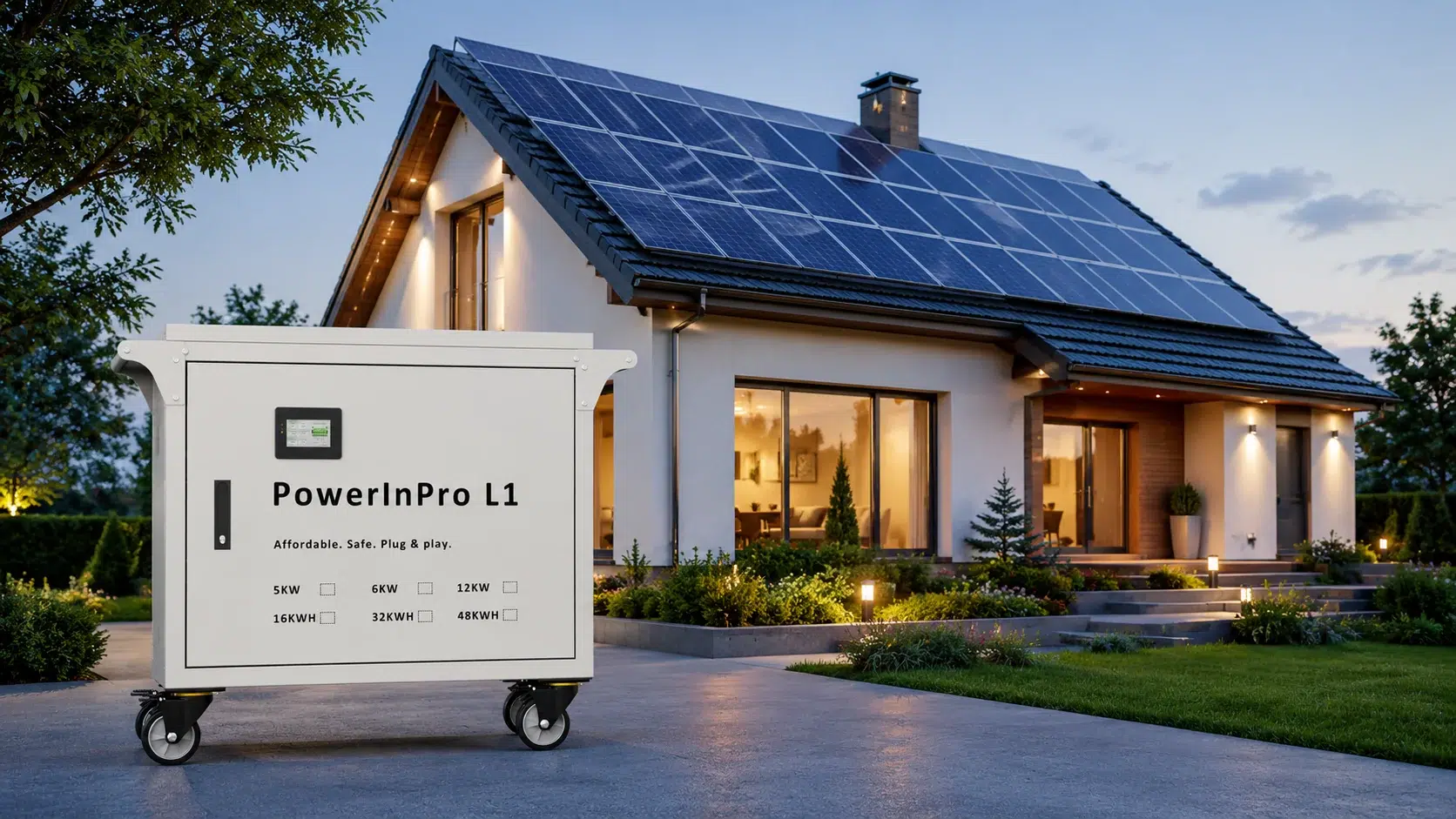
PowerInPro 5000 combines 5,000W output with 5,120Wh to 10,240Wh storage and a stated 10kW surge capacity. For larger stationary or compound-level needs, PowerInPro L1 offers published storage configurations from 16kWh to 48kWh and inverter options from 5kW to 12kW.
LiFePO4 Battery Storage
ANETHIC lists 12.8V, 51.2V and 76.8V LiFePO4 battery families, including customizable voltage and capacity options. Its 12.8V range covers 30Ah to 314Ah, while its 51.2V range includes 105Ah, 230Ah, 280Ah and 314Ah formats.
LiFePO4 technology is used because of its cycle life, thermal stability and suitability for frequent charging and discharging. Buyers should still confirm usable capacity, depth-of-discharge limits, BMS protections, operating temperature, cell traceability and warranty conditions.
Build a Solution Around the Load Profile
Step 1: Measure Demand
List every load, running watts, starting watts, quantity and daily operating hours.
Daily energy demand (Wh) = watts × quantity × operating hours
For motor-driven equipment, include starting surge and surge duration. For lighting, define the hourly dimming profile rather than assuming full power all night.
Step 2: Model Renewable Supply
Use location-specific solar data, shading, panel orientation and seasonal weather. A solution provider should disclose assumptions for system losses, temperature, battery aging and low-sun periods.
Step 3: Define Resilience
Identify which loads must remain operational and for how long. This prevents oversizing the complete system when only a subset of loads is critical.
Step 4: Select a Charging Strategy
Solar-only systems suit autonomous applications with an adequate energy budget. Solar-grid hybrid systems provide another charging path where continuity has priority.
Evaluate the Provider's Engineering and Supply Capabilities
Ask a prospective renewable energy equipment manufacturer or supplier for:
- Current product datasheets
- Battery and inverter test documentation
- Solar input limits and panel configuration
- Continuous and surge ratings
- Electrical protection and BMS details
- Installation and commissioning guidance
- Warranty and spare-parts plan
- Destination-market certification evidence
- Similar project references
- OEM, factory and wholesale capabilities
ANETHIC states that it operates in more than 90 countries and provides customized recommendations, remote training and after-sales support. Treat these as initial qualification claims and verify the service scope in the quotation and contract.
Model ROI Without Hiding the Assumptions
Compare renewable and conventional alternatives over the same project period. Include:
- Equipment and installation
- Panels, mounting and cabling
- Electricity or fuel
- Transport and fuel-delivery logistics
- Inspection and cleaning
- Battery and inverter replacement assumptions
- Downtime risk
- Financing and residual value
For portable power, cost per operating day may be more useful than a simple payback period. For solar lighting, avoided trenching and grid extension can materially change the business case.
Frequently Asked Questions
What projects can ANETHIC support?
The public product portfolio covers solar lighting, mobile and stationary power, LiFePO4 storage and customized off-grid or hybrid configurations.
Can one renewable energy provider supply every project component?
Not always. Civil works, local installation, permitting and grid interconnection may require local partners. Define the supplier's exact scope and interface responsibilities before contracting.
How should a buyer compare quotations?
Use a compliance schedule so bidders respond to the same load profile, autonomy, environmental, certification, service and warranty requirements.
Discuss a Renewable Energy Configuration
Send ANETHIC your load list, operating schedule, site location, voltage standard, resilience target and delivery destination. Request a documented configuration, technical assumptions and commercial proposal.