Construction teams need power before permanent utilities are available—and often in places where noise, fuel delivery and exhaust create operational problems. A properly sized solar generator for construction can supply site lighting, communications, laptops, monitoring equipment and selected electric tools with quiet, local power. It can also support mobile crews, temporary offices and remote field operations.
The key phrase is “properly sized.” A portable power station should never be selected by inverter wattage alone. Buyers must assess continuous load, starting surge, daily energy demand, charging opportunities, output compatibility and the consequences of downtime.
Where Solar Power Adds Value on a Jobsite
A solar generator can be deployed for:
- Temporary offices, laptops, routers and charging stations
- LED task lighting and security lighting
- Surveying, inspection and communications equipment
- Cameras, access-control systems and environmental sensors
- Portable kitchens and welfare-area equipment
- Selected pumps, fans and power tools within rated limits
- Emergency backup for critical low- and medium-power loads
Because requirements differ by trade and construction phase, ANETHIC offers systems from a compact 3,000W class up to configurable energy-storage platforms with 12kW inverter options.
Match the ANETHIC Power Station to the Load
PowerInPro X1: Portable 3,000W Jobsite Power
PowerInPro X1 is available in 230V and 120V versions. ANETHIC lists a 3,000W rated output, 6,000W peak output and 3,072Wh LiFePO4 battery. Dual solar and grid charging gives contractors flexibility: recharge from solar when conditions allow, or from the grid when temporary mains becomes available. An integrated BMS provides battery protection and operating oversight.
This class can suit mobile crews, temporary workstations, electronics, lighting and tools whose running and starting requirements remain within the unit's specifications. Buyers should confirm socket types, frequency and regional electrical compatibility before ordering.
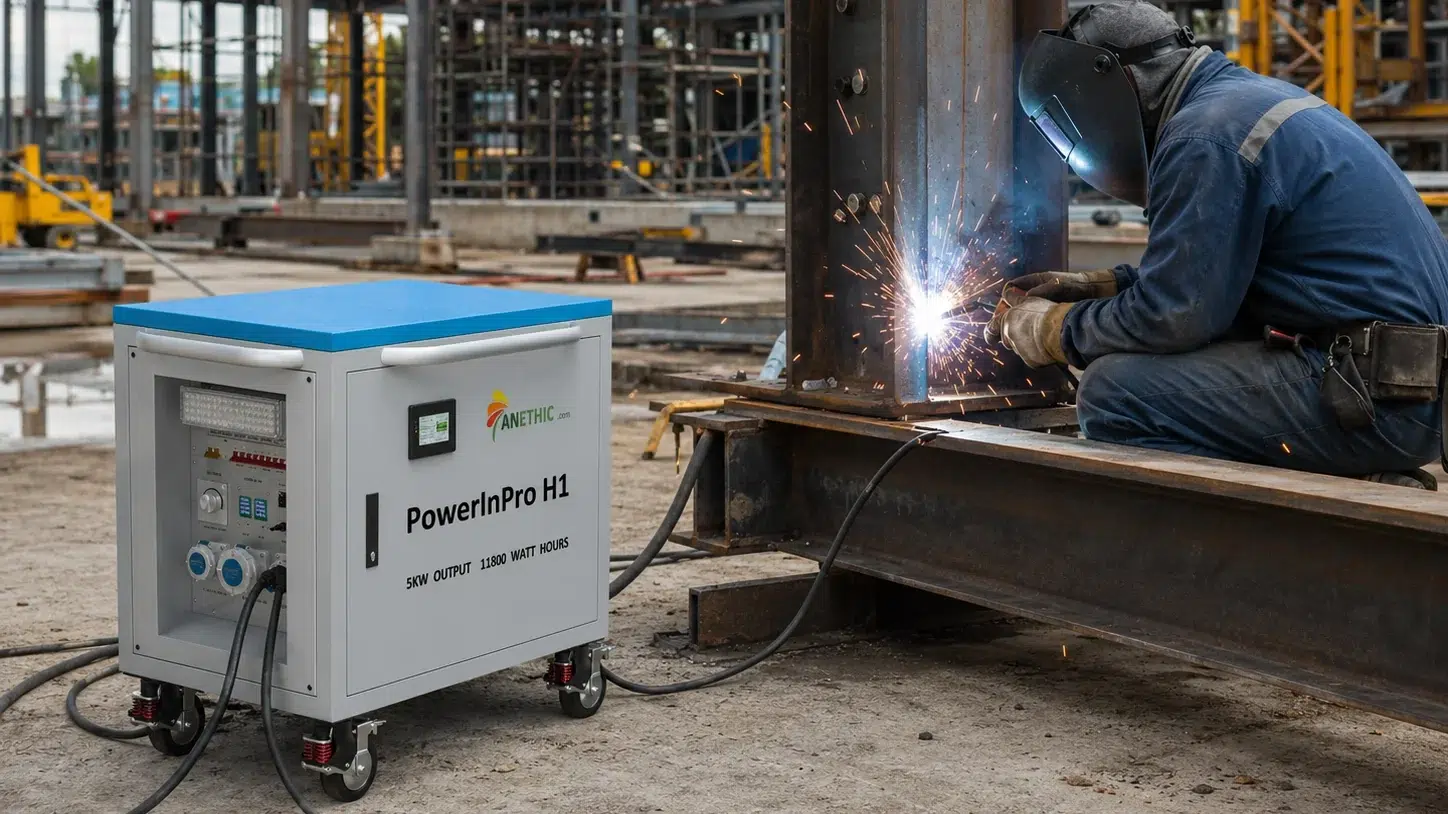
PowerInPro H1: A Mobile Power Hub for Construction Operations
PowerInPro H1 is positioned for higher-demand mobile applications, with published power options from 5,000W to 10,000W peak and hybrid solar-grid charging. Its cabinet integrates LiFePO4 storage, power management, outlets, USB and Type-C charging, DC outputs and a 50W high-CRI anti-glare work light.
ANETHIC's published interface details include 230Vac input and output, 15A and 20A outlets with a stated 20A combined maximum, two 24V DC outputs rated up to 240W each, and a solar charging input of 120–380Vdc below 20A. These values should be verified against the latest model datasheet and the intended load schedule.
PowerInPro 5000 and PowerInPro L1: More Runtime and Scalable Capacity
PowerInPro 5000 combines a 5,000W output class with 5,120Wh to 10,240Wh storage, 10kW surge capacity and solar-plus-grid charging. For site compounds, longer-duration backup or larger energy requirements, PowerInPro L1 offers published storage configurations from 16kWh to 48kWh and inverter options from 5kW to 12kW.
These larger systems may reduce recharge frequency or support more simultaneous loads, but the correct choice still depends on a measured energy budget.
A Simple Sizing Method for Procurement Teams
Step 1: Build a Load Schedule
List every device, its running watts, starting or surge watts, quantity and hours of use per shift. Do not assume that every nameplate load runs continuously.
Daily energy demand (Wh) = watts × quantity × operating hours
For example, four 50W LED work lights used for six hours require 1,200Wh. Add laptops, chargers, communications and tool usage separately. Then include a design margin for conversion losses, temperature, battery aging and unexpected demand.
Step 2: Check Continuous and Surge Power
The inverter must support the combined loads that operate at the same time. Motors, compressors and some tools can draw a short starting current well above their running wattage. Confirm the actual surge requirement with the equipment manufacturer and compare it with both the generator's peak rating and allowed surge duration.
Step 3: Calculate Recharge Time and Solar Input
Battery capacity answers only half the question. Establish how much energy must be restored each day, then assess local peak-sun hours, panel orientation, shading and seasonal weather. Keep grid or another approved backup charging path where continuous operation is mission-critical.
Step 4: Confirm Electrical and Site Compatibility
Verify voltage, frequency, socket standard, grounding, protective devices, cable ratings, ingress protection, ambient operating range and placement requirements. A competent person should review deployment under applicable local electrical and construction-site rules.
ROI: Look Beyond Fuel Savings
The business case for a solar generator can include:
- Reduced fuel purchases and fuel-delivery logistics
- Less generator noise near workers, residents or sensitive sites
- No engine exhaust at the point of use
- Lower engine servicing and fewer consumable parts
- Flexible deployment before grid connection
- Hybrid charging that uses available solar and grid power
However, an honest comparison should include solar panels, transport, charging downtime, battery utilization and backup-power requirements. Model cost per operating day or cost per delivered kWh for the actual project duration. A battery generator is often most valuable when it is assigned to the loads that benefit most from quiet, clean and reliable power, rather than being treated as a universal replacement for every high-demand machine.
Questions to Ask a Solar Generator Manufacturer or Supplier
Before placing a wholesale, fleet or project order, request:
- Latest product datasheet and battery capacity
- Continuous output, surge output and surge duration
- Usable energy under the proposed duty cycle
- Solar input range and compatible panel configuration
- Charging time by solar and grid input
- Output voltage, frequency and receptacle configuration
- BMS and electrical protection details
- Warranty terms, spare-parts plan and after-sales process
- Packaging, transport classification and lead time
- OEM, branding or custom-configuration availability
ANETHIC states that its power products use LiFePO4 batteries and BMS protection and that project-specific guidance and support are available. Buyers should place the agreed specification, acceptance criteria and support scope in the purchase contract.
Compare ANETHIC's portable power station range and consult the OSHA electrical safety resources when planning safe jobsite deployment.
Frequently Asked Questions
Can a solar generator run construction tools?
It can run tools whose simultaneous continuous and surge loads fit the inverter and outlet limits. Verify each tool, especially motor-driven and heating equipment, before connection.
Is 3,072Wh enough for a full shift?
That depends on the load schedule. Divide usable stored energy by average load for a rough runtime estimate, then allow for system losses and site conditions. High-power tools can deplete storage quickly.
Can the system charge without sunlight?
ANETHIC's listed PowerInPro products support solar-plus-grid charging, providing a second charging route when sunlight is limited or grid power becomes available.
Get a Construction Power Configuration and Quote
Send ANETHIC a load list showing running watts, starting watts, quantity and daily operating hours. Include the site country, voltage standard, expected solar conditions, mobility needs and required backup time. The team can recommend a PowerInPro configuration for technical review.
Ready to move your project forward?